John A. Gaut, EAS Master Beekeeper
Northeast Beekeepers
September 2026
The varroa mite has been a problem for honey bee colonies in North America since 1987, when the mite, originally from Asia, was introduced into the United States. Varroa destructor parasitizes both adult bees and developing pupae. While parasitism weakens the bees, the transmission of viruses is the primary driver of colony mortality. After nearly 40 years of selection pressure, some honey bee colonies have developed traits that suppress mite reproduction in capped brood. These traits are commonly referred to as Varroa Sensitive Hygiene (VSH). Like honey production, temperament, and other genetic traits, VSH can be used as a selection criterion for queen rearing.
Selection for VSH traits requires testing in several steps. Routinely using an alcohol wash to check mite populations on adult bees is a good initial indicator of mite loads. Colonies that consistently have less than 1% mites without treatments are good prospects for further testing. Additional assays include the pin test (following the COLOSS protocol and scored at 24 hours), the Rapid Capping Removal method, the Unhealthy Brood Odor (UBeeO) test (scored after 3 hours), and the Harbo Assay. The Harbo Assay is the most direct and reliable test for selecting for VSH, though it requires trained assessors and significant time.
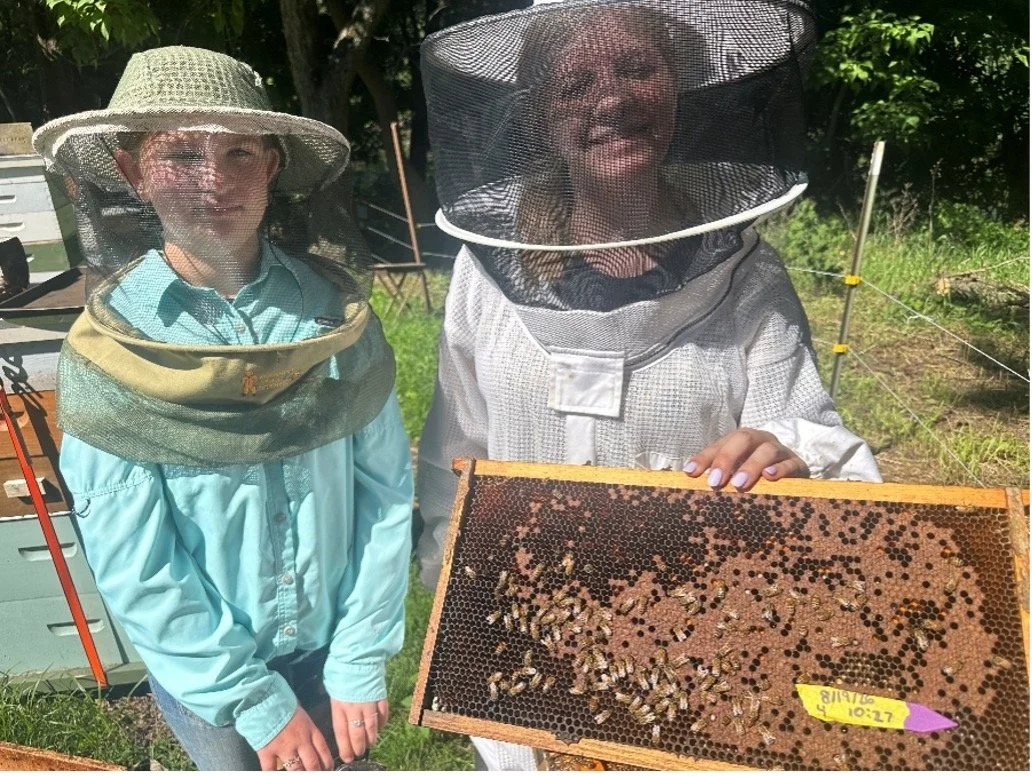
Alyssa DeJessie and Bridget Torcivia (New Jersey Honey Ambassador) assisted with the testing. Thank you, Alyssa and Bridget. Photo by John Gaut.
Our groups tested 12 colonies using all four methods, beginning on August 18, 2026.
Initially, 12 colonies were selected for testing. Some were full-sized production colonies and others were smaller nucleus colonies (nucs). Nucleus colony numbers carry an “N” prefix. Some pin-test and UBeeO results are missing because of lost photos.
We determined that several queens may make good mother stock for queen rearing in 2027. N17 and N20 were mother queens for grafting in 2026 and performed well in these tests. N17 is the Blue Line and N20 is the Violet Line. Daughters of both lines performed well through the summer and into the fall. N40 may also be a good mother queen; that colony built quickly and stored more honey than adjacent colonies. N35, N36, N37, N38, and N39 will likely be used as drone-mother colonies. Ideally, drones from these colonies will mate with grafted queens from all six of the lines typically produced each season.
The Rapid Capping Removal method proved difficult in practice. While removing the cappings with a wax strip was straightforward, the uncapped pupae on the frame often did not remain after being knocked out of the cells, and the subsequent alcohol wash was difficult to read. The sharp impact required to remove the test pupae also dislodged a significant amount of other brood on the frame, likely setting the colony back. We do not recommend this method for routine use without substantial modification.
Below is the data from the selected colonies and the results of the testing. Also included are a few pictures of the Harbo Assay testing and the Rapid Capping Removal.
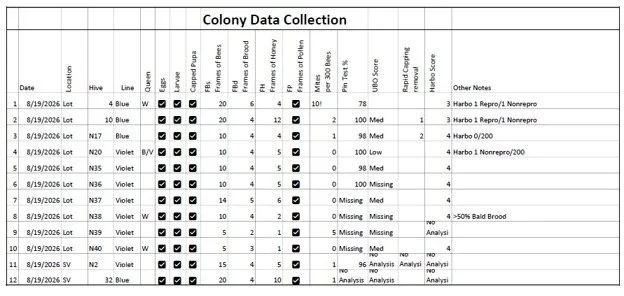
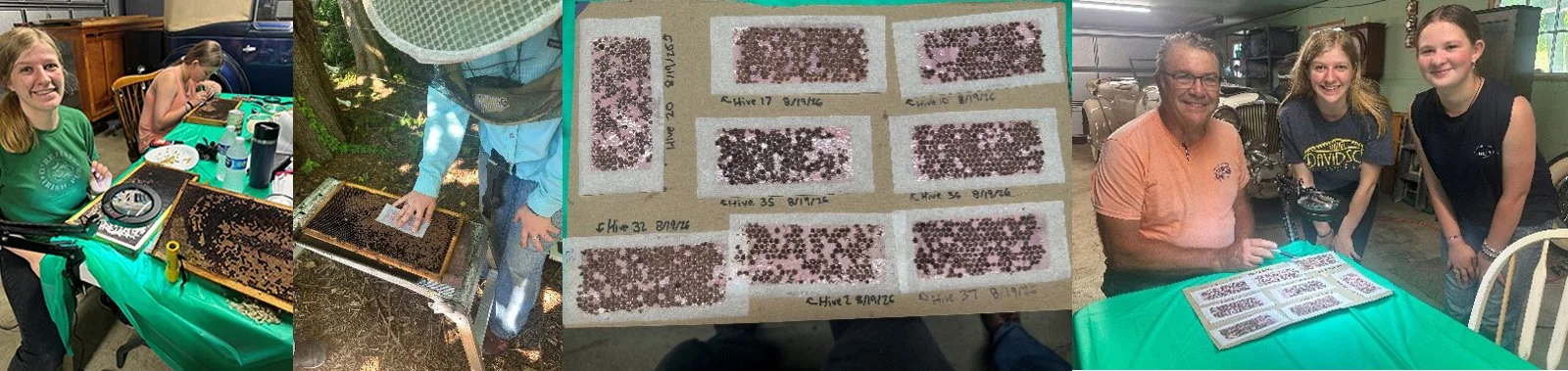
Photo 1:
Harbo Analysis: Bridget and Alyssa open mature pupa cells and look for mites. Picture by John Gaut
Photo 2: Rapid Capping Removal: Alyssa is applying the wax strip to capped brood. Picture by John Gaut
Photo 3: The undersides of the cappings are evaluated for any recapping. Picture by John Gaut
Photo 4: John Gaut, Bridget Torcivia, and Alyssa DeJessie. Picture by Kim Nagle